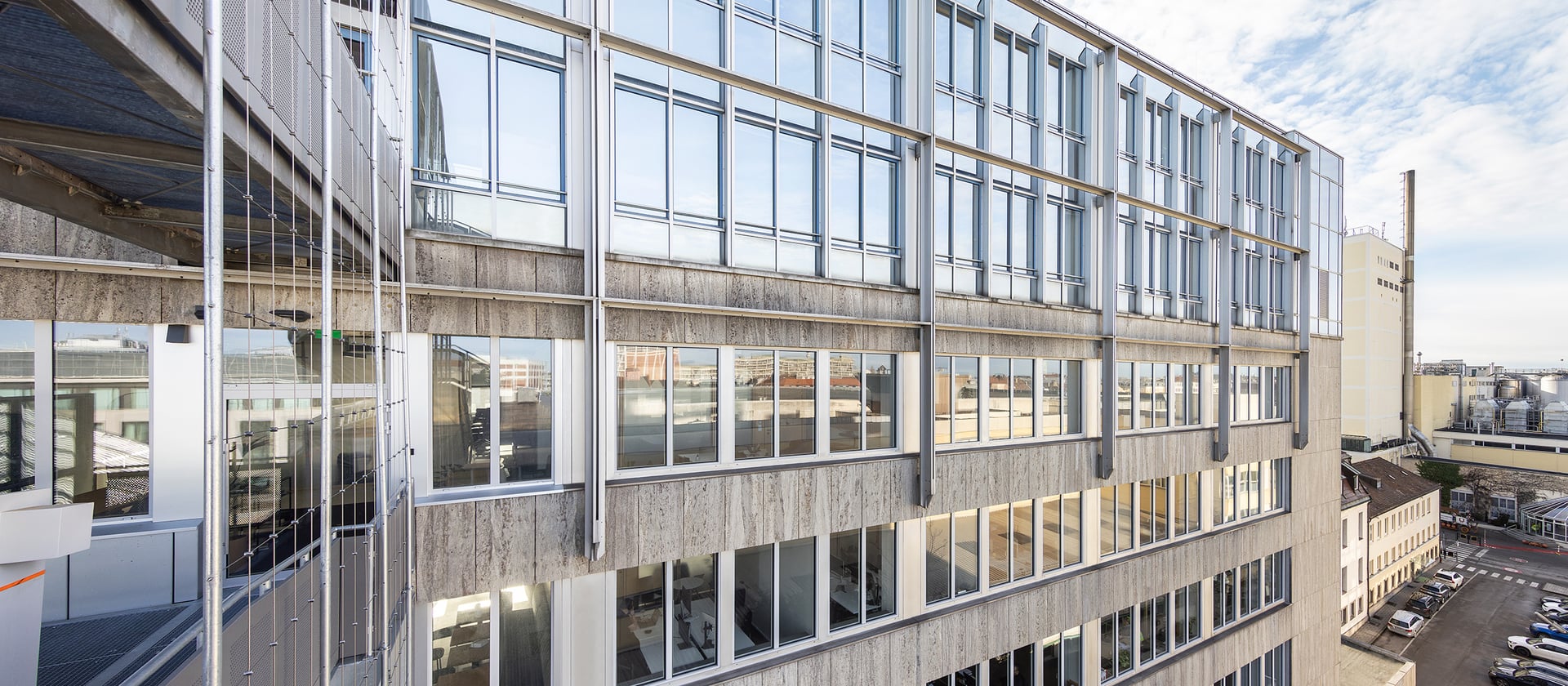
Total refurbishment instead of demolition.
In 1969, the Spaten brewery commissioned a six-storey administrative building on Munich’s Marsstraße, with another two storeys added at a later date.
Along with the main brewery headquarters and the listed Late Gothic tuff stone “Burgfriedenssäule” (a civic boundary marker) on the same plot, it formed a small square-like ensemble with green space opening out onto the street. In 2022, Munich’s Sedlmayr Grund und Immobilien AG decided on a complete modernisation. Demolition or complete refurbishment? That was the question.
The Spaten building stood in an urban spatial dialogue with the building opposite that houses BR, Bavaria’s public broadcaster. The two buildings here in Munich’s Maxvorstadt district form a harmonious urban ensemble together with the other neighbouring buildings: a harmony of materials, volumes, building and storey height, chromatics and architectural idioms. The façades of the Spaten and BR buildings are distinguished by a strict vertical and horizontal organisation. The horizontality arises from the window configuration and the cladding with thick panels of Roman travertine. After five decades the building was no longer fit for contemporary needs – particularly the subdivision of space – and the property company was left to decide how to keep the site attractive for tenants and users.
The Spaten building stood in an urban spatial dialogue with the building opposite that houses BR, Bavaria’s public broadcaster. The two buildings here in Munich’s Maxvorstadt district form a harmonious urban ensemble together with the other neighbouring buildings: a harmony of materials, volumes, building and storey height, chromatics and architectural idioms. The façades of the Spaten and BR buildings are distinguished by a strict vertical and horizontal organisation. The horizontality arises from the window configuration and the cladding with thick panels of Roman travertine. After five decades the building was no longer fit for contemporary needs – particularly the subdivision of space – and the property company was left to decide how to keep the site attractive for tenants and users.
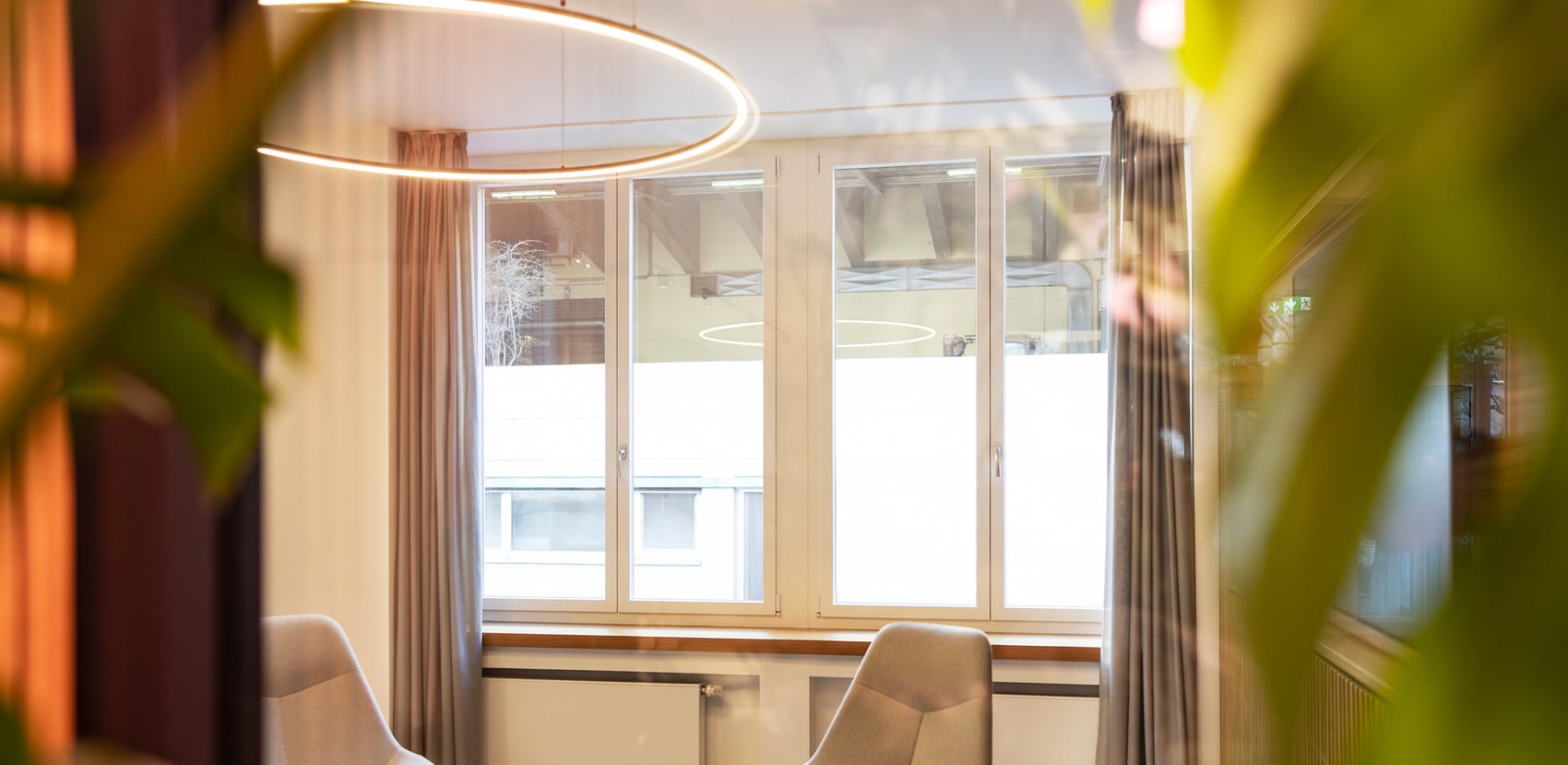
The result of the total refurbishment: elegant, modern spaces bounded by attractive, high-grade windows offering maximum user comfort.
The building isn’t listed, either individually or as part of an ensemble, so demolition and rebuilding would have been an option. But ultimately the client decided to retain the building and completely refurbish it. While economic considerations might have been the deciding factor to begin with, it has since become clear that complete refurbishment was the right decision in every respect. Ultimately the positive aspects – the building’s continued presence in the city’s architectural mosaic and the character of the street, the huge volumes of grey energy saved by forgoing demolition and rebuilding – were not in conflict with the modernisation requirements. On the contrary, in fact. Today each floor boasts generously proportioned open-plan offices that benefit from solid construction and light streaming in from both sides.
The key measures were removing the subdivisions of the original individual rooms and corridors, and installing modern building and electrical technology along with new flooring. The building technology runs along the white-painted concrete ceiling, much of it visible. Overall it gives a contemporary, casual, raw impression. The new floor construction and bright, monochrome stone-look facings offer better sound insulation against footfall and also make the space look bigger.
The key measures were removing the subdivisions of the original individual rooms and corridors, and installing modern building and electrical technology along with new flooring. The building technology runs along the white-painted concrete ceiling, much of it visible. Overall it gives a contemporary, casual, raw impression. The new floor construction and bright, monochrome stone-look facings offer better sound insulation against footfall and also make the space look bigger.
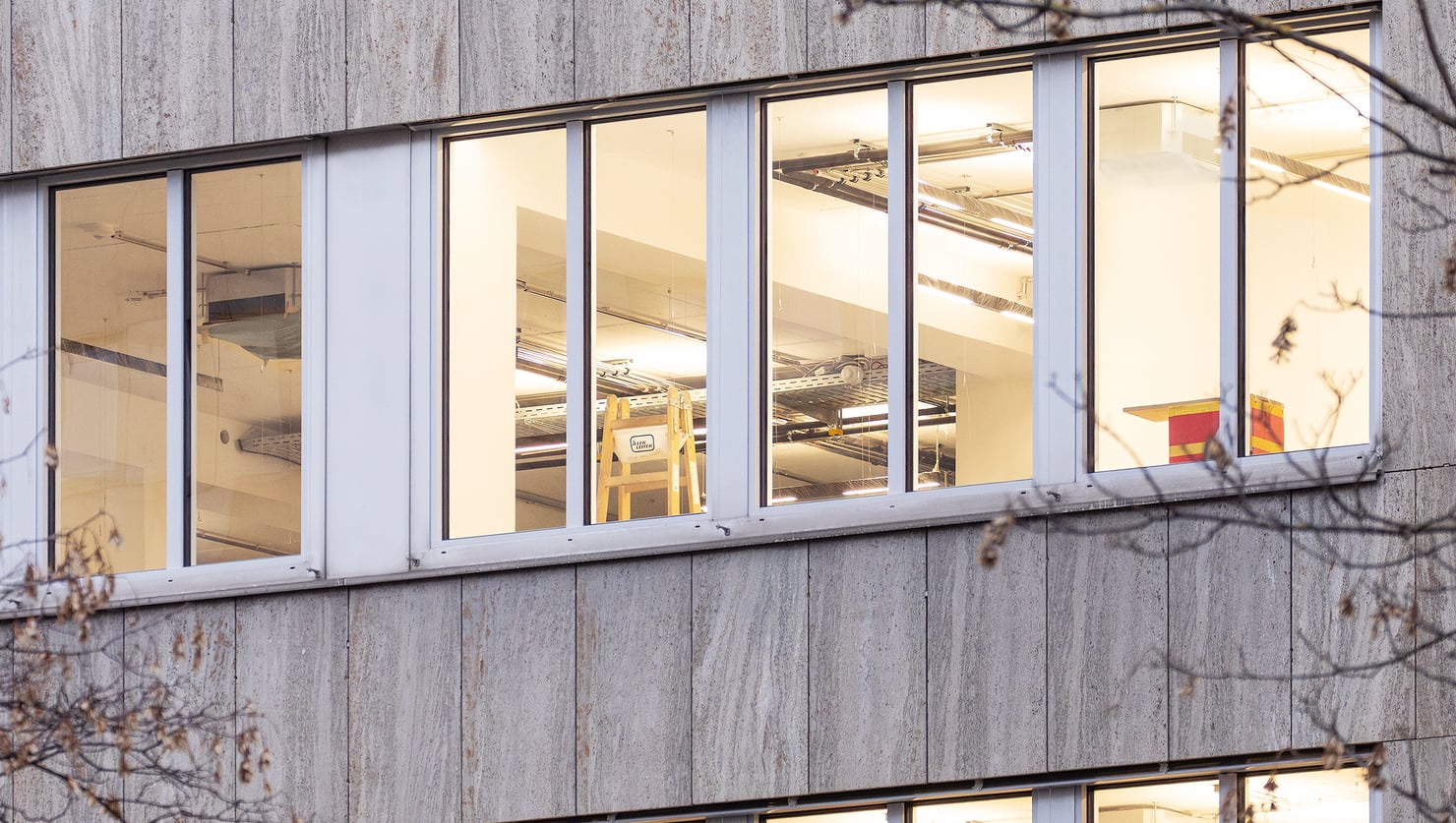
An urban façade distinguished by travertine panels and window elements in a clear, horizontal arrangement.
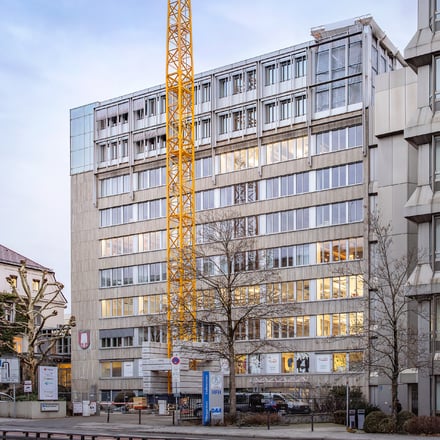
The refurbishment preserves the architectural heritage. Two additional storeys offer more space without changing the character of the whole.
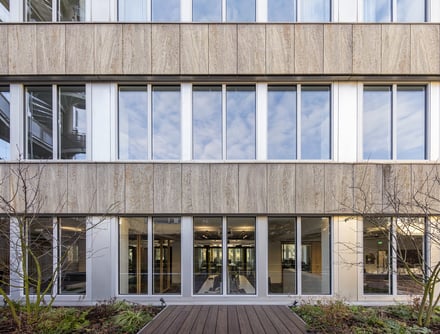
The numerous corridors and small offices are replaced with generously proportioned, light-flooded spaces. Slender window frames make the most of the available daylight.
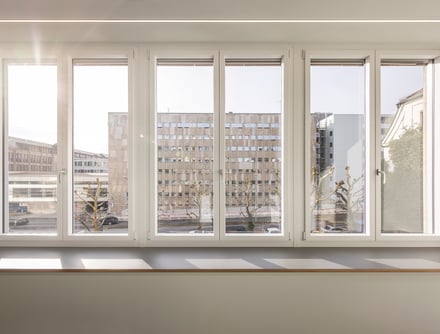
The double-sash windows offer far greater user comfort than their single-sash predecessors.
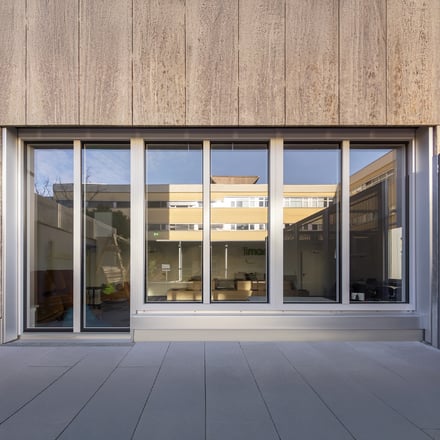
On this major project, window replacement was a key element of the successful refurbishment.
On each floor the light now cascades from the north-east and the south-west into the large spaces that occupy the entire depth of the building. With the open-plan offices, meeting rooms, communal kitchens and rest areas, it’s difficult to imagine that just a few short months ago this was a warren of corridors with rows of boxy little offices. There is a large and elegant meeting room fitted with the latest technology in the ground-floor lobby area, which all the companies in the building can book. Largely untouched, on the other hand, is the simple elegance of the original light green staircase, with its stone steps and filigree handrails. Large-format vintage photos of Spaten through the years offer a modest account of the history of the space. The prime location and the modern, high-quality offices with their cosy atmosphere now make the site a coveted option for numerous companies once again. The opportunity to work here has lured employees out of the home-office mode that many of the individual companies retained even after the end of the pandemic.
And then of course there’s the windows, which had a starring role in this complete refurbishment. Finstral’s slide-in installation method meant the window replacement process was quick, sensitive, reliable and high quality. And even with this method, the slender profile of the Nova-line sash ensured there was no loss of window area. It’s a method that truly has a wealth of benefits for this kind of construction project. It enables windows to be replaced without intervention in the shell of the building, or the thermal and structural damage that can result. And you can also replace single-leaf windows with double-leaf while retaining the supporting structure, as here in Marsstraße. The FIN-Window Nova-line windows in aluminium for the outer and uPVC for the inner allow greater flexibility in interior space utilisation, while the significantly lower weight also reduces the strain on moving and supporting parts. The saving in weight can be invested in good double glazing without burdening the structural elements. And the replacement is much quicker than a normal window replacement, with minimal damage to the building. On the Marsstraße site, Finstral managed to replace the windows at a rate of one floor a week, so in just six weeks all the storeys being refurbished were fitted with new windows.
The unanimous verdict today is that this window replacement was key to the success of the refurbishment as a whole. The installation was quick, straightforward and planned down to the smallest detail, and the new double-sash windows offer a high degree of interior comfort with optimal sound protection and airtightness, thermal insulation in winter, good heat protection in summer, and a high degree of energy efficiency.
Project profile:
Property: Commercial building with office space
Construction task: Window replacement
Architects: Ingenieurbüro Jürgen Konrad
Year of construction: 1969;
Year of refurbishment: 2023
Total area: 6,005 m²
Locality: Munich, Germany
Finstral elements:
And then of course there’s the windows, which had a starring role in this complete refurbishment. Finstral’s slide-in installation method meant the window replacement process was quick, sensitive, reliable and high quality. And even with this method, the slender profile of the Nova-line sash ensured there was no loss of window area. It’s a method that truly has a wealth of benefits for this kind of construction project. It enables windows to be replaced without intervention in the shell of the building, or the thermal and structural damage that can result. And you can also replace single-leaf windows with double-leaf while retaining the supporting structure, as here in Marsstraße. The FIN-Window Nova-line windows in aluminium for the outer and uPVC for the inner allow greater flexibility in interior space utilisation, while the significantly lower weight also reduces the strain on moving and supporting parts. The saving in weight can be invested in good double glazing without burdening the structural elements. And the replacement is much quicker than a normal window replacement, with minimal damage to the building. On the Marsstraße site, Finstral managed to replace the windows at a rate of one floor a week, so in just six weeks all the storeys being refurbished were fitted with new windows.
The unanimous verdict today is that this window replacement was key to the success of the refurbishment as a whole. The installation was quick, straightforward and planned down to the smallest detail, and the new double-sash windows offer a high degree of interior comfort with optimal sound protection and airtightness, thermal insulation in winter, good heat protection in summer, and a high degree of energy efficiency.
Project profile:
Property: Commercial building with office space
Construction task: Window replacement
Architects: Ingenieurbüro Jürgen Konrad
Year of construction: 1969;
Year of refurbishment: 2023
Total area: 6,005 m²
Locality: Munich, Germany
Finstral elements:
- Window FIN-Window Nova-line 90+8 Aluminium-uPVC
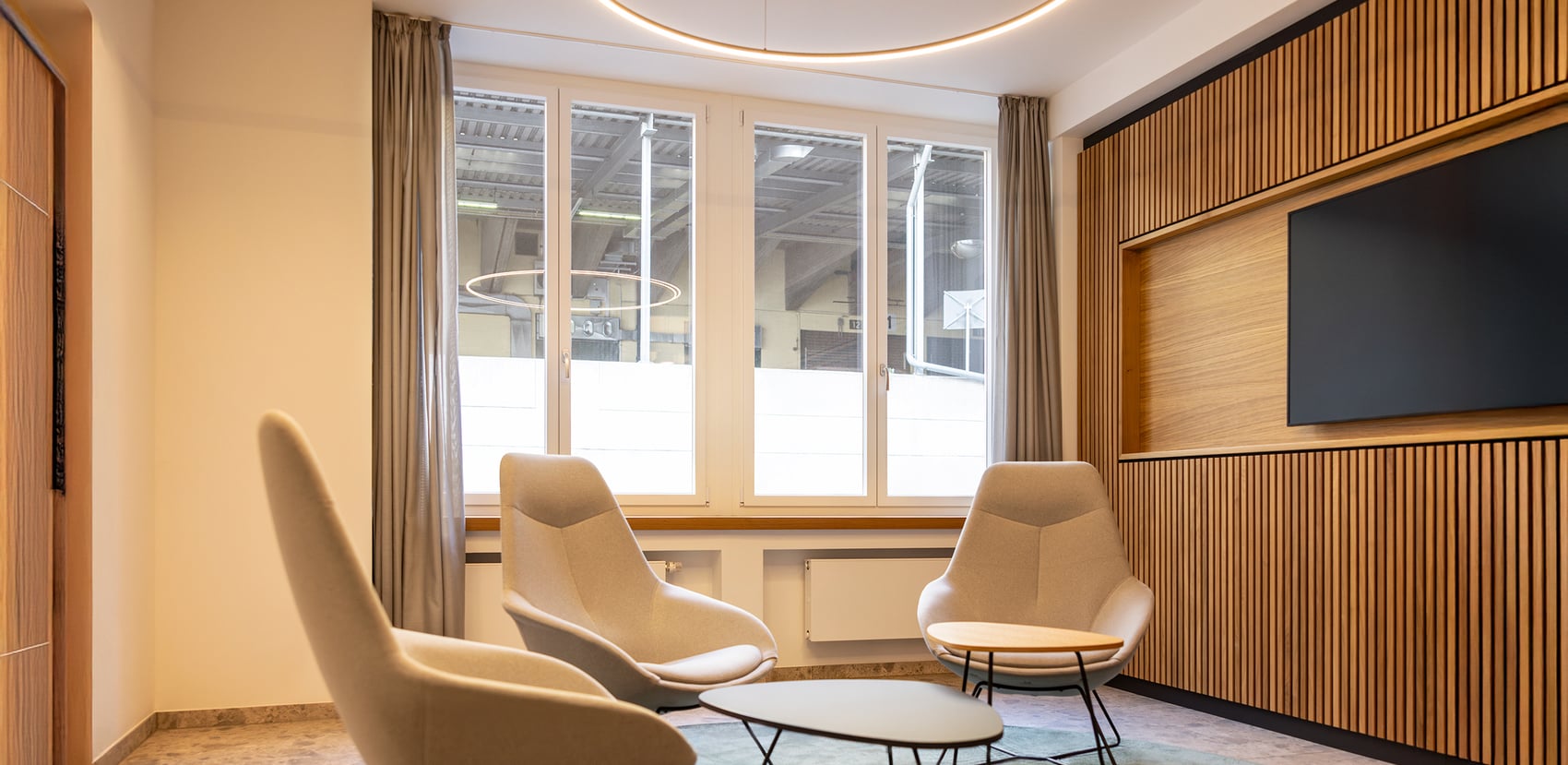
The soft white of the uPVC windows makes for bright rooms with a feel-good factor.
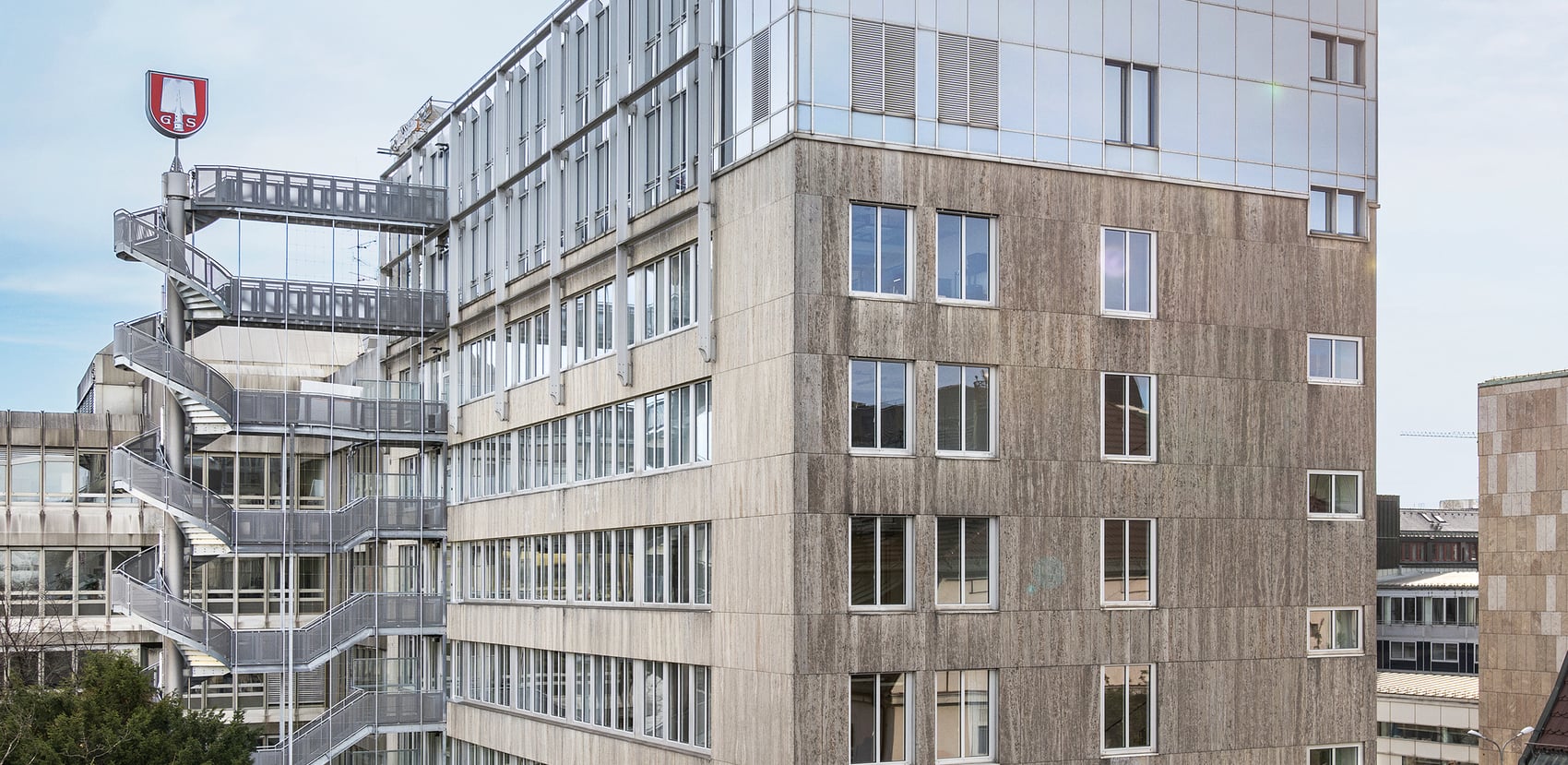
Conservation of the building’s civic and architectural presence and avoidance of the masses of embodied energy a demolition and new-build scheme would have involved in no way conflicted with the modernisation requirements.
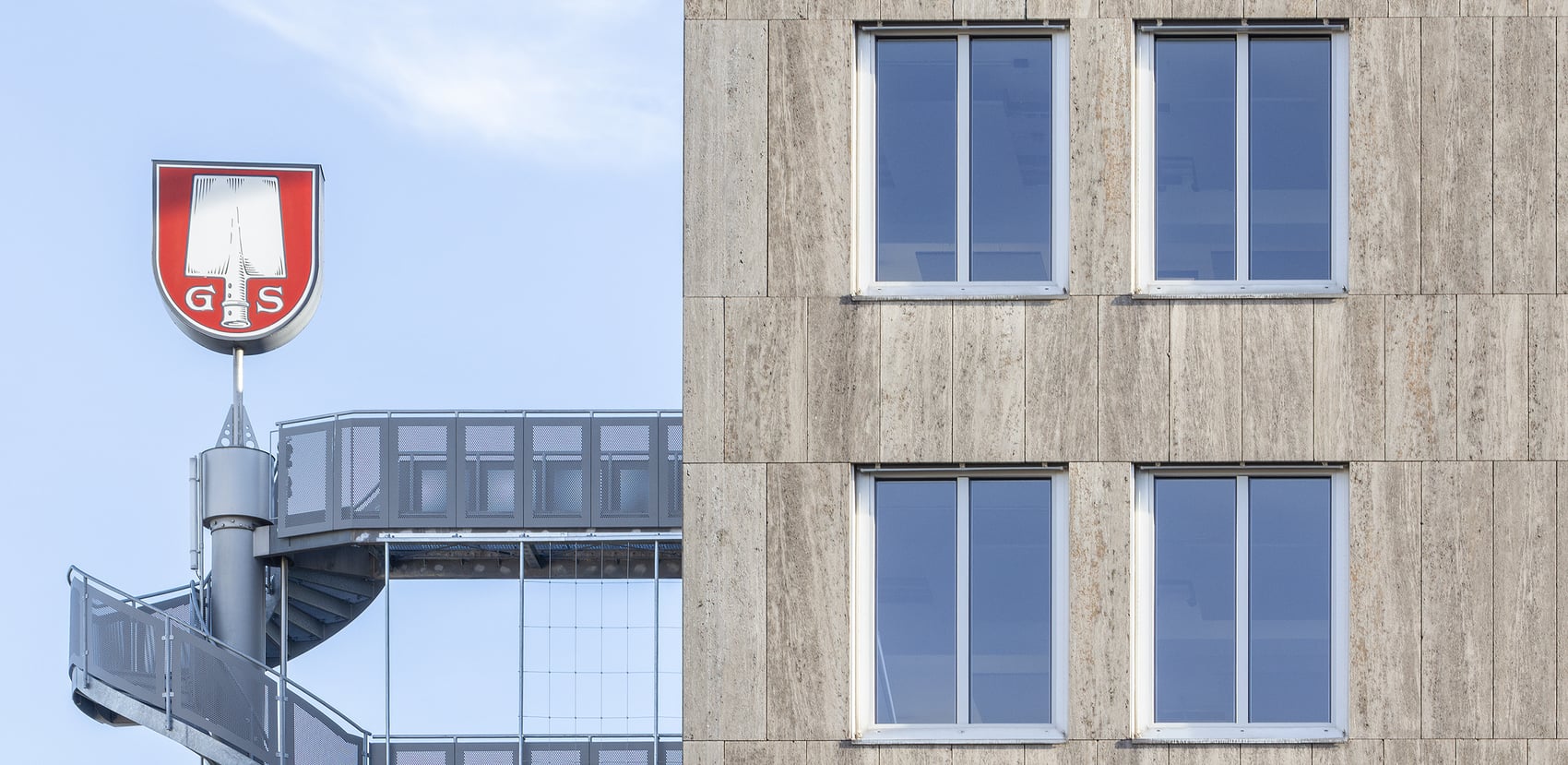
The building’s dominant feature is its strict horizontal and vertical façade configuration.
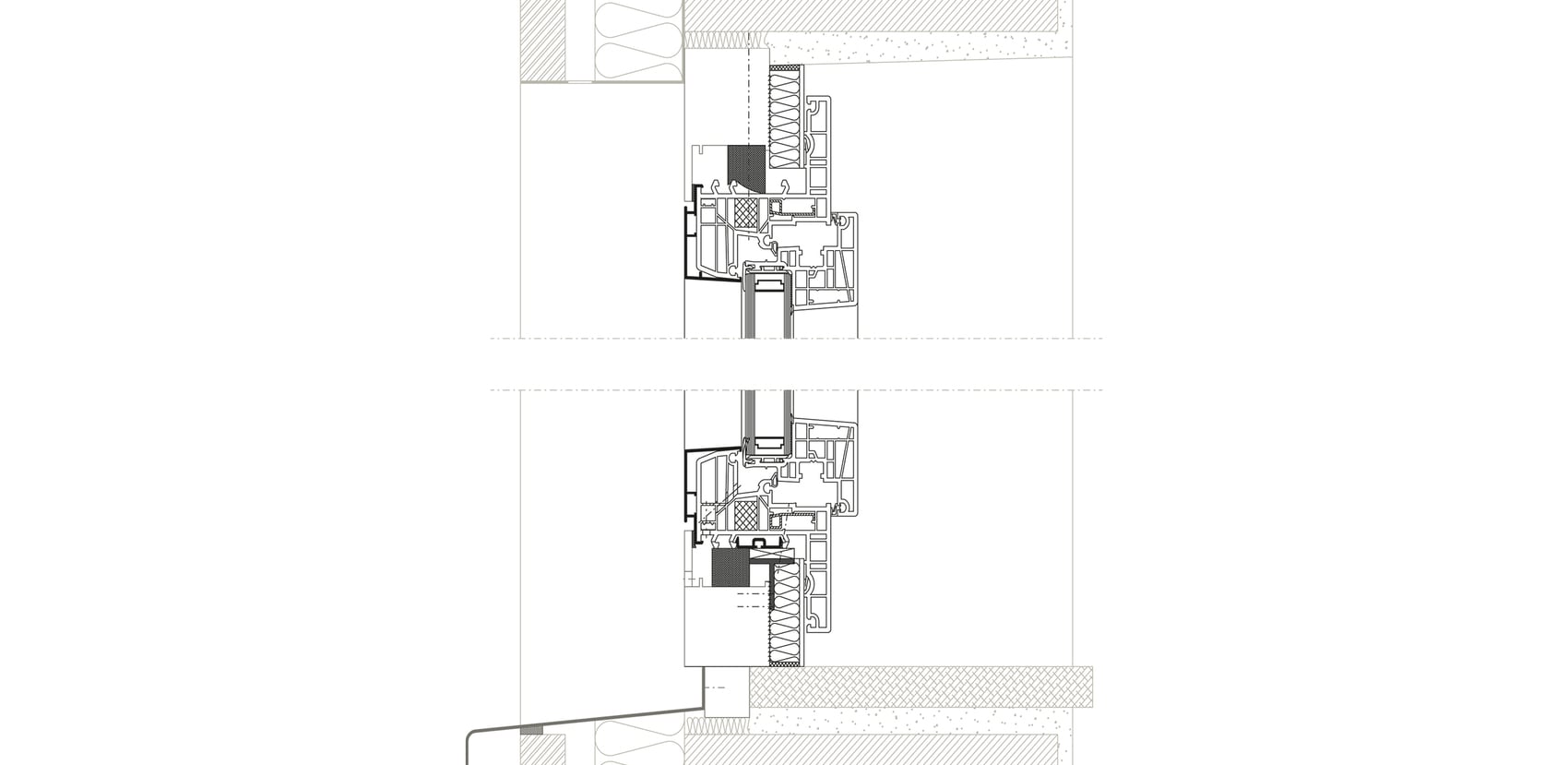
Building connection
The existing aluminium ribbon windows were refurbished using the minimally invasive slide-in installation method. Instead of tearing the existing windows and their frames from the reveal, which would have damaged the masonry as well as the posts between the windows, the sashes and the old fittings were removed. The existing frames were then fitted with a new frame with the latest in insulation quality, pushed in from inside. At the same time the posts were faced with hard foam plates pre-cut prior to delivery. The new frameless sashes leave the building’s outward appearance unchanged. Using the ift-certified installation method made the replacement much cheaper and easier than the conventional approach.
The existing aluminium ribbon windows were refurbished using the minimally invasive slide-in installation method. Instead of tearing the existing windows and their frames from the reveal, which would have damaged the masonry as well as the posts between the windows, the sashes and the old fittings were removed. The existing frames were then fitted with a new frame with the latest in insulation quality, pushed in from inside. At the same time the posts were faced with hard foam plates pre-cut prior to delivery. The new frameless sashes leave the building’s outward appearance unchanged. Using the ift-certified installation method made the replacement much cheaper and easier than the conventional approach.
Still want more?
See here for further interesting reading matter.


Where urban and green space meet - a residential complex opens onto a park.
At home in an urban landscape: different systems, a single architectural language.