Back to high-quality construction.
Feedback from Christine Lemaitre.

The crises of recent years have set in train a process of transformation that will fundamentally change our accustomed way of living and doing business. Sustainability is essential in this process. We can only secure the basis of our existence through conscious, proportionate action. So the direction in which need to develop is clear. As for how we achieve this – well, we already have extensive experience and potential solutions. So now we have to put this all into action, in every area of society, no ifs or buts.
In construction, we essentially need to return to a concept of high quality. Durability is key here. Good, sustainable buildings exemplify high quality, with long lifecycles and impressive levels of user satisfaction. We need to be thinking in usage durations of 100 to 500 years again. Gone are the days when property served as a capital investment with no further outlay required. The quality criteria will instead be factors like sufficiency, and the associated question – how much is enough? What do I really need? What can I do without? How much space, material and technology do we require? How do we repurpose and expand buildings easily? At the same time, essentially positive developments like circular construction shouldn’t fool us into thinking we can continue consuming vast quantities of materials and construction components with a clear conscience just because recycling potential is planned into our building projects. Our task is always to take meaningful actions that correspond with the construction project, in which economic, environmental and sociocultural factors are seen as a single entity. We have to consider the whole lifecycle of the building – from smart, forward-looking planning to the maintenance it will require. That also includes thinking about dismantling or repurposing, which is often ignored. But the idea that good, sustainable buildings are necessarily more expensive is a myth. Forward-looking planning alone can reduce construction costs, and operating costs are significantly lower than they are for conventional buildings. They are also longer-lasting, which means they offer greater investment security.
When it comes to truly meaningful measures, however, preserving existing structures takes precedence. Retaining what we have and converting it for further use is the only way to save resources and carbon while also maintaining our architectural identity. This requires greater openness. Cities in particular have numerous empty spaces, because they have outlived their original function, for instance. A shift in perspective and the courage to enable new uses for people help in many ways.
We have to move away from short-term trends, questionable fashions and the constant need to differentiate. We need to create a liveable, well-designed, well-constructed environment and make it accessible to all – a place where all people feel safe and free to live healthy lives, regardless of age, origin, skin colour, income or gender. Discussions about who gets to define the terms, about individual business models are irrelevant here. But it is a point of interest that, according to recent studies, existing buildings and their energy consumption are often better than assumed. New buildings, on the other hand, often require more energy than estimates forecast – yet another clear argument for retaining existing structures.
We are facing a gigantic mission of transformation and rebuilding, and we need our entire industry on board. There is so much to do. But it comes with the opportunity for each of us to be a pioneer and to go beyond the current requirements with every construction project – from individual structures to infrastructures. That is where our responsibility lies.
In construction, we essentially need to return to a concept of high quality. Durability is key here. Good, sustainable buildings exemplify high quality, with long lifecycles and impressive levels of user satisfaction. We need to be thinking in usage durations of 100 to 500 years again. Gone are the days when property served as a capital investment with no further outlay required. The quality criteria will instead be factors like sufficiency, and the associated question – how much is enough? What do I really need? What can I do without? How much space, material and technology do we require? How do we repurpose and expand buildings easily? At the same time, essentially positive developments like circular construction shouldn’t fool us into thinking we can continue consuming vast quantities of materials and construction components with a clear conscience just because recycling potential is planned into our building projects. Our task is always to take meaningful actions that correspond with the construction project, in which economic, environmental and sociocultural factors are seen as a single entity. We have to consider the whole lifecycle of the building – from smart, forward-looking planning to the maintenance it will require. That also includes thinking about dismantling or repurposing, which is often ignored. But the idea that good, sustainable buildings are necessarily more expensive is a myth. Forward-looking planning alone can reduce construction costs, and operating costs are significantly lower than they are for conventional buildings. They are also longer-lasting, which means they offer greater investment security.
When it comes to truly meaningful measures, however, preserving existing structures takes precedence. Retaining what we have and converting it for further use is the only way to save resources and carbon while also maintaining our architectural identity. This requires greater openness. Cities in particular have numerous empty spaces, because they have outlived their original function, for instance. A shift in perspective and the courage to enable new uses for people help in many ways.
We have to move away from short-term trends, questionable fashions and the constant need to differentiate. We need to create a liveable, well-designed, well-constructed environment and make it accessible to all – a place where all people feel safe and free to live healthy lives, regardless of age, origin, skin colour, income or gender. Discussions about who gets to define the terms, about individual business models are irrelevant here. But it is a point of interest that, according to recent studies, existing buildings and their energy consumption are often better than assumed. New buildings, on the other hand, often require more energy than estimates forecast – yet another clear argument for retaining existing structures.
We are facing a gigantic mission of transformation and rebuilding, and we need our entire industry on board. There is so much to do. But it comes with the opportunity for each of us to be a pioneer and to go beyond the current requirements with every construction project – from individual structures to infrastructures. That is where our responsibility lies.
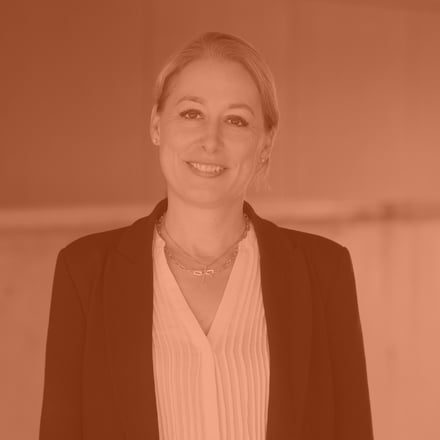
Christine Lemaitre studied construction engineering at the University of Stuttgart before working as a structural engineer in the USA. She joined the University of Stuttgart as a research assistant in 2003, before moving to Bilfinger Berger AG in 2007, where she was a project manager. In 2008 she received her doctorate. Since 2009, Lemaitre has been active in the German Sustainable Building Council (DGNB), initially as head of the System Department and since 2010 as CEO. She is currently Chair of the Climate Positive Europe Alliance (CPEA) network and the Wissensstiftung (Knowledge Foundation). She is also a member of the Advisory Council for Building Culture in the German state of Baden-Württemberg and the Sustainability Board of the Central Property Committee, and Chair of the Board of Directors of the Cradle to Cradle Product Innovation Institute.
Reframe Resilience
Find more helpful information on this topic here.