


- Long-term thinking and resource-efficient action
- News
Finstral set to be carbon-neutral by 2030.
This mindset, on the one hand, embraces economic and social aspects – both the sound conduct of business and the consistently fair treatment of employees, suppliers, partners and customers. On the other hand, it drives our constant efforts to reduce our ecological footprint. In all three areas, we set ourselves ambitious targets and single-mindedly ensure that they are met.
How to get better and better.
“Though small successes can be quickly achieved, that’s not enough,” says Florian Oberrauch, Vice-President of the Board of Directors, who is in charge of production and logistics. “Genuinely sustainable action is highly complex because it necessitates the continuous, painstaking scrutiny and optimisation of all processes.” Finstral’s efforts to improve its ecological footprint must be understood not only in terms of its impressive part-successes, but also through the transparent communication about its methodical approach. “To systematically refine our processes,” explains Florian Oberrauch, “we have been operating a certified environmental management system to ISO 14001 since 1999 and an energy management system to ISO 50001 since 2014. This has truly brought us forward.”
Finstral’s next step involves developing a comprehensive tool for assessing its environmental performance: the Finstral Environmental Impact Board. This transparently records all factors – from manufacture, including upstream and downstream activities, to the effects of product use. “The board is designed on the basis of the internationally recognised Greenhouse Gas Protocol (GHG). Alongside greenhouse gas emissions, however, we also take account of other environmentally relevant issues, such as water consumption and waste,” explains Katrien Romagnoli, Head of the Energy and Environment department at Finstral. “This provides a seamless overview that enables us to systematically identify new strategies for further reducing our ecological footprint.”
Mindful of all environmental impacts.
To act sustainably, you must first know your ecological footprint. The Environmental Impact Board enables Finstral to keep systematic track of its emissions and its emitters. It presents a selection of ongoing measures and records some of the progress we have already achieved.
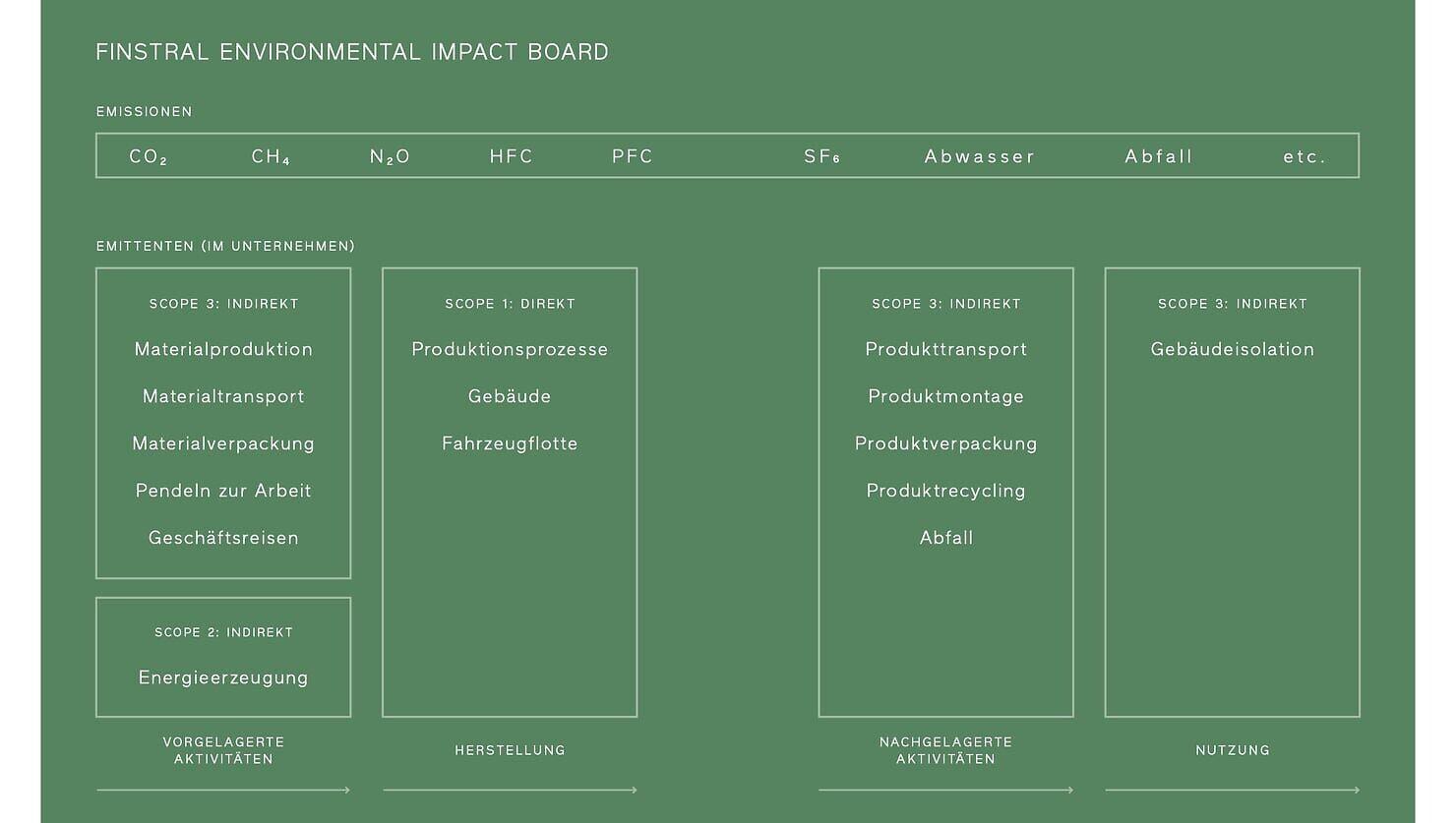
Finstral environmental impact board.
CSR Report (in progress)
Finstral's first corporate sustainability report is under preparation.
Environmental product declarations
EPDs for various material combinations used in Finstral windows have been available since 2022: uPVC, uPVC-aluminium, aluminium and aluminium-wood. finstral.com/epd
- CO2
Carbon neutrality (in progress)
Company's carbon footprint through production and business operations (Scope 1 and 2) by 2030: 0 t
Material Production
Recycled uPVC
Proportion of recycled uPVC granulate in uPVC production volume in 2023: 20 %
Lower-carbon uPVC
43 % of uPVC purchased in 2023 was produced with green electricity.
Glass recycling
Quantity of glass residue from production process returned to supplier in 2023: 4.2 t
Secondary aluminium
Phased switchover of product range to secondary aluminium, with average recycled proportion in 2023 of 47 % for our aluminium profiles
Material Packaging.
Packaging of supplied components
Systematic optimisation of packaging materials for supplied components. This repeatedly brings about drastic reductions.
Energy Production.
Green energy
Reduction of carbon emissions through gradual switchover to green electricity for production, use of district heating and implementation of energy efficiency measures (2023 compared to 2012): – 78 %
Photovoltaics (in progress)
Proportion of total electricity consumption met by in-house photovoltaic systems on roofs of factory and office buildings or through other renewable energy sources (as from 2025): 20 %
The installed photovoltaic capacity by the end of 2024 runs to 4.2 MWp.
Vehicle Fleet.
Transportation
By 2024, our truck fleet had been largely converted to HVO biodiesel, thus achieving 81.5 % lower carbon emissions than with diesel.
Production Processes.
Bonding instead of setting on blocks
At Finstral, insulating glass units are always bonded to the sash frame. As a result, it is the glass, not the frame, that lends the sashes their stability. This enables Finstral to optimise material use, i.e. to extrude much slimmer sash profiles while incorporating only half as much steel reinforcement as normal. Resulting annual savings in steel (2023 compared to 2012): – 3,202 t
Water
Fresh water savings in aluminium coating through operation of in-house treatment system in 2023: 1,356 m³
Wood, glass and aluminium efficiency (in progress)
Reduction in energy demand for production of wooden frames, insulating glass units and aluminium coating (by 2025 compared to 2021): – 5 %
Profile extrusion efficiency
Reduction in energy demand (kWh/kg) for extrusion of Finstral uPVC frame profiles (by 2023 compared to 2012): – 26 %
Window production efficiency
Reduction in energy demand (kWh/target time) for production of window and door units (by 2023 compared to 2012): – 25 %
Product Installation.
Minimally invasive wooden window replacement
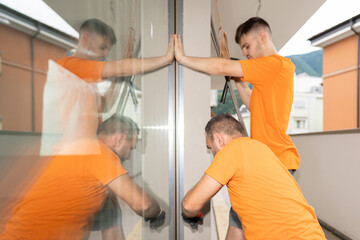
Two hours instead of one day per window, hardly any building disturbance, ift-certified: Finstral has been installing new windows on existing wooden frames since 1978 and has played a key role in making the slide-on installation method the recognised standard throughout Europe.
Minimally invasive uPVC or aluminium window replacement (in progress)
Around one hour per window, no dirt, no building disturbance, ift-tested: Finstral is working towards establishing slide-in installation as the time-efficient, pan-European industry standard for replacing old uPVC or aluminium windows. This method will at least double the speed of window replacement for the same manpower.
Two-stage installation (in progress)
Boosts efficiency, reduces damage to the building fabric and radically simplifies any later window replacement: Finstral is working towards establishing two-stage installation (frame mounted during wet construction phase, finished window only fitted after completion of “messy” site operations – already commonplace in southern Europe) as the pan-European industry standard.
Product Transportation.
Protective packaging
Windows are in any case only sparingly packaged. Through systematic optimisation, we ensure that packaging materials are used more economically and increasingly comprise pure, unmixed components for easier disposal.
Reduced polystyrene use
Since 2024, the switchover to wooden protective packaging for the transportation of doors has achieved annual savings in polystyrene of 3.7 t.
Product Recycling.
In-house window recycling (in progress)
The in-house recycling of old windows (since 2024) at the Oppeano plant has served to close the material cycle for the direct sales territory between South Tyrol and Verona.
Building Insulation.
- Optimum insulation performance
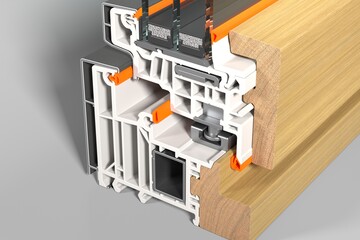
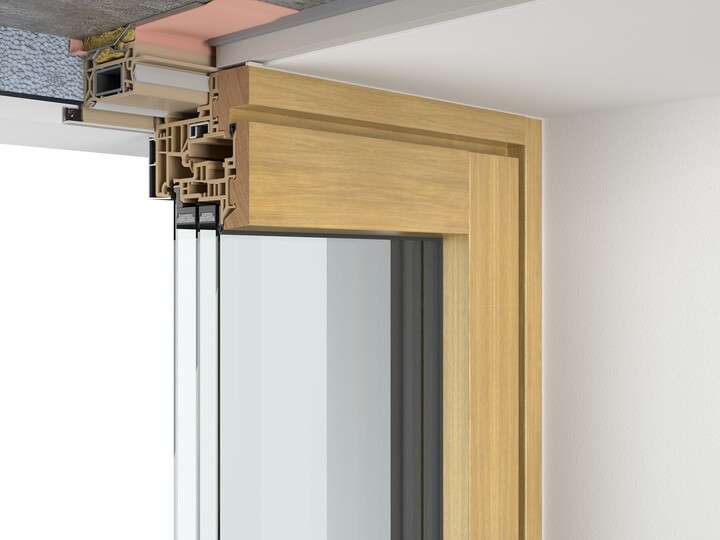
- Finstral windows boast outstanding insulation values coupled with a minimised mix of constituent materials. Our best-selling, aluminium-frame FIN-Project Nova-line, for example, comprises only four materials
(aluminium, uPVC, gasket, adhesive tape) while achieving a Uw value of 1.0 W/m²K.
SCOPE 1: Emissions from owned or operated facilities
SCOPE 2: Emissions from purchased energy
SCOPE 3: Emissions from other areas
Finstral has operated a certified environmental management system (to ISO 14001) since 1999 and a certified energy management system (to ISO 50001) since 2014.
The Finstral Environmental Impact Board is based on the Greenhouse Gas Protocol (GHG).
Experience variety first-hand – at our Finstral Studio.
Do you just want to inspect, touch and try out our products? At the Finstral Studio, you will find a wide range of windows, doors and glass walls. Along with expert answers to your questions.
Share